
Seller guide
How to Identify a Bus Plug
The line it fits matters more than the amp rating. Here is how to work out which line you have.
- Paid before removal
- No testing required
- Dismantling and rigging on us
- Freight always covered
Request a Quote
Have equipment to sell while you read? Send a nameplate photo for a same-day number.
Start with the nameplate, and read all of it
Most people read the amp rating off a plug and stop there, which is understandable and also skips the important part. The rating tells us the size of the load it was serving. The busway line tells us who can use it, and that is what sets the value. A 400 amp unit for a line with thousands of installations still running is worth substantially more than a 400 amp unit for a line that barely sold.
The plate usually carries a catalog or type number that encodes the line, sometimes as an obvious name and sometimes as a prefix buried in a longer string. Photograph the whole plate rather than transcribing the part that looks relevant, because the part that looks irrelevant is often the part we need.
Fusible or breaker, and why it matters
Fusible units contain a switch and a set of fuse clips. Breaker units contain a molded case circuit breaker. From outside, the quickest tell is the handle and the label: fusible units are marked for fuse class and size, breaker units carry a trip rating and usually a breaker catalog number of their own.
Both have active resale markets and neither is automatically worth more. Fusible units are mechanically simpler and hold up better after long storage. Breaker units carry a second component with its own independent value, which sometimes exceeds the value of the housing it sits in.
When the plate is gone, read the housing
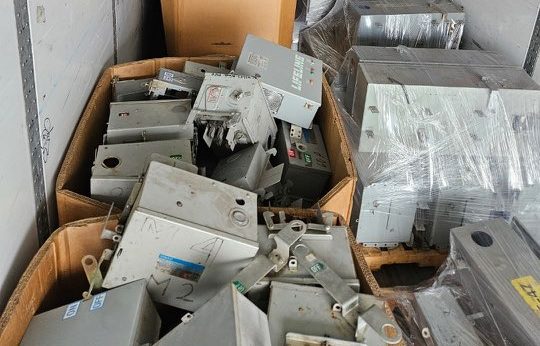
Case proportions, the number and style of latches, whether the cover hinges or lifts off entirely, the shape of the operating handle and the position of the interlock are all line-specific. So is the stab arrangement on the back, which is the part that actually engages the busway and therefore the part that cannot be generic.
This is the most reliable identification route available without a plate, and it is entirely routine for anyone who works with this equipment weekly. Send front, side and back photographs and you will normally get an answer without any guesswork on your part.
Hand-written markings are real data
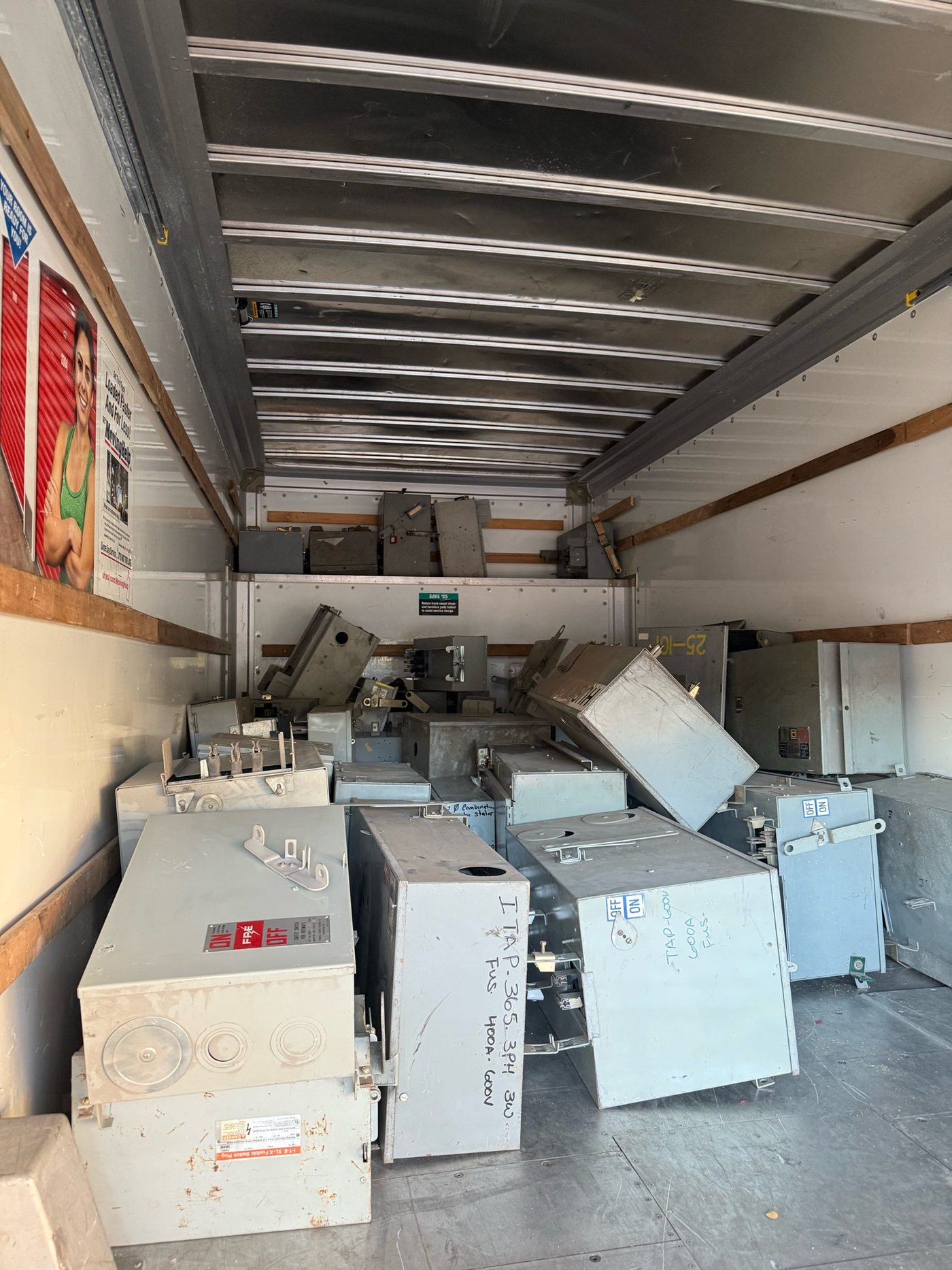
Plant electricians write on these covers. Amp ratings, circuit numbers, the name of the machine the plug fed, fuse sizes, installation dates. In our own inventory we regularly see units marked things like 250 AMP or TAP 400A 600V in grease pencil, and that writing is frequently the fastest route to identifying a unit whose plate corroded away years ago.
Photograph it exactly as it is rather than cleaning the cover first. Cleaning has removed more useful information from bus plugs than corrosion ever has.
What condition details we actually look at
Whether the handle throws through its full travel. Whether the interlock still engages. Whether the stabs are clean or burned and pitted. Whether the case is straight or has been dropped. Whether there is evidence of water having stood inside it. That is essentially the whole list.
Notice what is not on it: we do not need electrical test results, insulation resistance readings or any certification of function. We grade condition physically, from your photos and then in person, and that responsibility stays entirely with us.
If you cannot tell, send it anyway
Identification is our job and not a prerequisite for getting a quote. A photograph of something you cannot name is a perfectly normal way to start this conversation, and it happens on a large share of the lots we buy.
Request a Quote
A nameplate photo gets the fastest number.
Other seller guides
Everything worth knowing before you sell
Funds change hands before a single section leaves your property. There is no consignment and no waiting on a downstream resale.
Our own crew takes the run down. You are not sourcing riggers, renting lifts or chasing a carrier who has never handled busway before.
You are never asked to test, megger or certify anything. We grade from physical condition and the nameplate. That is the entire process.
Fusible plugs, breaker units, bus duct, tap boxes, panelboards and starters all on one job is the normal case rather than the exception.
How to Identify a Bus Plug: quick answers
Straight answers
Can you identify a plug from a phone photo?
Usually yes, provided the photo is in focus and shot straight on. Two or three angles makes it close to certain.
Does the fuse or breaker have to still be in it?
No. Empty housings have value on their own, and we buy loose fuses and breakers separately as well.
What if my units are all different?
Mixed lots are the normal case. Photograph each distinct type and we will price the lot as a whole.
Questions about your own equipment?
Call or text photos and we will tell you what you have.
Request Your Quote
Anywhere in the United States. No obligation.